The sentence test
The posture test measures the strength and endurance of the abdominal muscles. “It’s a sign of core strength and endurance,” says Kunal Makwana, personal trainer and founder of KMAK Fitness, “and it’s important for overall stability and posture.
How to do it
“Lie on your back with your knees bent and your feet flat on the floor,” says Makwana. “Cross your arms over your chest or put your hands behind your head without pulling on your neck. Raise your torso up to your knees and then return to the starting position. Count the number of sit-ups you can do in one minute.”
Criteria to aim for

“In your 20s and 30s, a good score for men would be 40-50 deadlifts and for women 35-45,” says Makwana. “In their 40s and 50s, men can aim for 30-40 deadlifts and women, 25-35.” Those in their 60s and 70s can aim for 20-30 deadlifts for men and 15-25 for women, and a good score for 80 plus would be 15-20 as a man and 10-15 as a woman.
How to improve your score
“To do better in this test, perform core exercises regularly – three to four times a week,” says Makwana. “Different types of ab exercises you can use include planks, leg raises and cycling. Gradually increase repetitions and use additional variations such as weighted deadlifts.
The push-up test
Focusing on the chest, shoulders and triceps, this push-up test measures overall upper body strength and endurance. “Consistent push-up performance can be a sign of good fitness and muscle health,” says Makwana.
How to do it
“Start in a high plank position with your hands slightly wider than shoulder-width apart,” says Makwana. “Lower your body until your chest almost touches the floor, keeping your body in a straight line. Then push back up to the starting position. Count the number of push-ups you can do in one minute.”
Criteria to target:
“Men in their 20s and 30s can aim for 29-35 push-ups, while a good score for women in this age range is around 15-20,” says Makwana. “In their forties and fifties, men can aim for 21-28 years and women 12-17 years. In the 60s and 70s, a good score for men would be 15-20 and for women, eight to 12. Finally, for 80-plus, men can work on 10-15 push-ups and women five to 10.”
How to improve your score
One of the best ways to improve your score is through consistent strength training, says Makwana. “Incorporate bench presses, dumbbell presses and tricep dips into your routine,” he advises. “Also, gradually increasing the number of push-ups over time helps, as does proper form.” For the latter, focus on keeping a straight line from head to heels to avoid injury and maximize function.
The elevator test
One of the most common health and fitness measures out there, the lift test involves sitting on the floor and standing up again. “The ability to both sit and stand unassisted from the ground, or even use just one hand, can mark people who will live longer,” says Jon Denoris, personal trainer and founder of Club 51 – Intelligent Fitness. “The test is related to physical strength, coordination and flexibility.”
How to do it
“Go from a standing position to sitting on the floor and then back up, without worrying about speed of movement, using the minimum amount of support you feel you need,” says Denoris. “You have a maximum of two minutes to perform this test.”
Criteria to aim for
“Start with five points for both movements (sitting down and standing up) to get a combined score of 10, deducting one point for each support used – for example, if you lean on something or use a hand,” says he. “For anyone over the age of 40, an overall score of eight is a great achievement and is associated with a longer lifespan. For those under 40, a perfect score of 10 should be what you’re aiming for.”
How to improve your score
“There are several ways to improve your mobility and therefore your ability to improve your score on this test,” says Denoris. “A regular full-body stretching routine, focusing on the lower back, hips, pelvis and hamstrings is key. Taking up yoga or Pilates will also help you improve your range of motion and balance.
Sit and pass the exam
If you suspect that you may not be particularly flexible, a sit-and-take test is a good way to measure it. “This test measures the flexibility of the lower back and hamstrings,” says Makwana, “which is important for overall mobility and injury prevention.
How to do it
“Sit on the floor with your legs extended straight ahead,” he says. “Slowly step forward as far as possible, keeping your knees straight. Measure the distance covered beyond the toes (if any).”
Criteria to aim for
“In their 30s and 30s, men can aim for 15-20 inches and women 17-22 inches (with 15 inches at the toes),” says Makwana. 20 inches. In your 60s and 70s, 10-15 inches is good for men and 12-17 inches for women. By 80-plus, 8 to 12 inches is good for men and 10-15 inches for women.
How to improve your score
“Develop a stretching routine that includes hamstring stretches, or take a yoga or Pilates class,” he says. “Consistency is key: try to stretch daily, holding each stretch for at least 30 seconds. It will be a case of gradual progress – increasing the volume gradually over time without forcing the stretch.
The back paw test
“This test assesses shoulder flexibility, which is important for upper body mobility and reduces injury,” says Makwana.
How to do it
“Stand up and reach one arm over your shoulder and down your back,” advises Makwana. “Reach your other arm behind your back and up toward your other hand. Measure the distance between your fingers.”
Criteria to aim for
“Among the younger generations – those in their twenties and thirties – a good result would be a finger overlap of one to three inches for men and two to four inches for women,” he says. “For those in their forties and fifties it would be good results for men’s fingers to overlap by one to three inches For women in their 60s and 70s, men may find their fingers within two inches of touching.Lastly, for 80-plus, a finger within four inches from contact would be a good result for men and two inches for women.
How to improve your score:
“Strength training can be very helpful here—shoulder presses and lat pulldowns are the best options for building and maintaining both strength and flexibility,” says Makwana. “It’s also a good idea to practice shoulder stretches and perform the back scratch test regularly to monitor progress.

The one mile walk test
Unlike the other tests, this one requires a fitness watch or other device that measures your heart rate. “It’s a valid predictor of VO2 max, which is a longevity marker,” says Denoris. “VO2 max measures how well your body uses oxygen, and knowing this level can help you measure your aerobic fitness and heart health.
How to do it
“First, warm up, then start the stopwatch and walk a mile,” he says. “Go as hard as you can without running.” At the end, record how long it took you, as well as your heart rate. You also need to know your weight.”
Criteria to aim for
“In the good old days, we would have to use a formula to get a VO2 max number from this test, but there are lots of calculators online now that can help,” he says. “I like the one at exrx.net/Calculators/Rockport, which estimates your performance based on your age.
How to improve your score
“You can use interval training to make rapid progress on this test,” says Denoris. “Interval training means a change of pace. For example, you can start with a five-minute walk at a leisurely pace, which also acts as a warm-up, and then walk faster for five minutes. This gives you a 10-minute block that you can repeat two or three more times before finishing with five minutes of slower walking to cool down.”
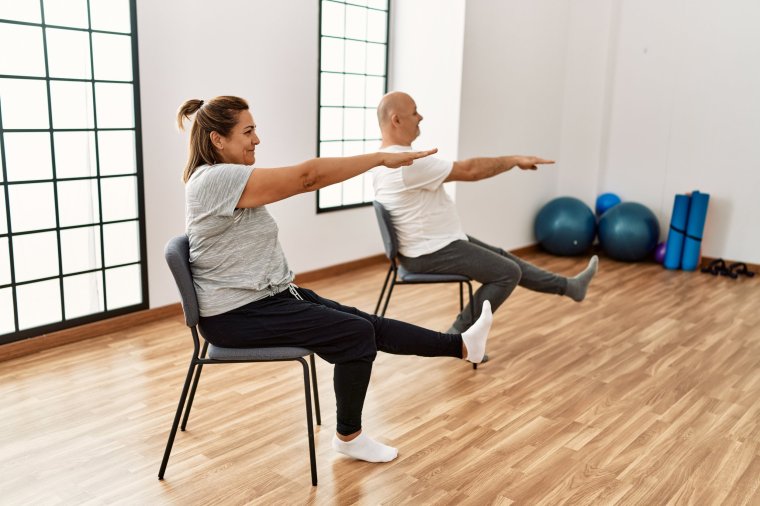
The chair stand test
This test measures the strength of the lower body, especially in the legs. “As we age, this lower body strength becomes increasingly important for daily activities,” says Makwana.
How to do it
“Sit in a chair with your arms crossed over your chest or straight out,” he says. “Stand up completely and then sit back down without using your hands. Count how many times you can do this in 30 seconds.”
Criteria to aim for
“In their 30s and 30s, men can aim for 22-28 platforms and women, 20-25, while in their 40s and 50s, 18-24 for men and 15-22 for women would be a good result,” says Makwana. “For the age group in the 1960s and 1960s, 14-19 would be good for men and 12-17 for women, and for 80-plus, a good score for men is around 10-15 and for women 8-12.” .”
How to improve your score
“Leg-strengthening exercises are a great way to improve your performance for this test, including squats, lunges and calf raises,” says Makwana. “You can also use stability and balance exercises like leg poses. Regular exercise is advisable: do chairstands daily to build endurance and strength.”
The plank test
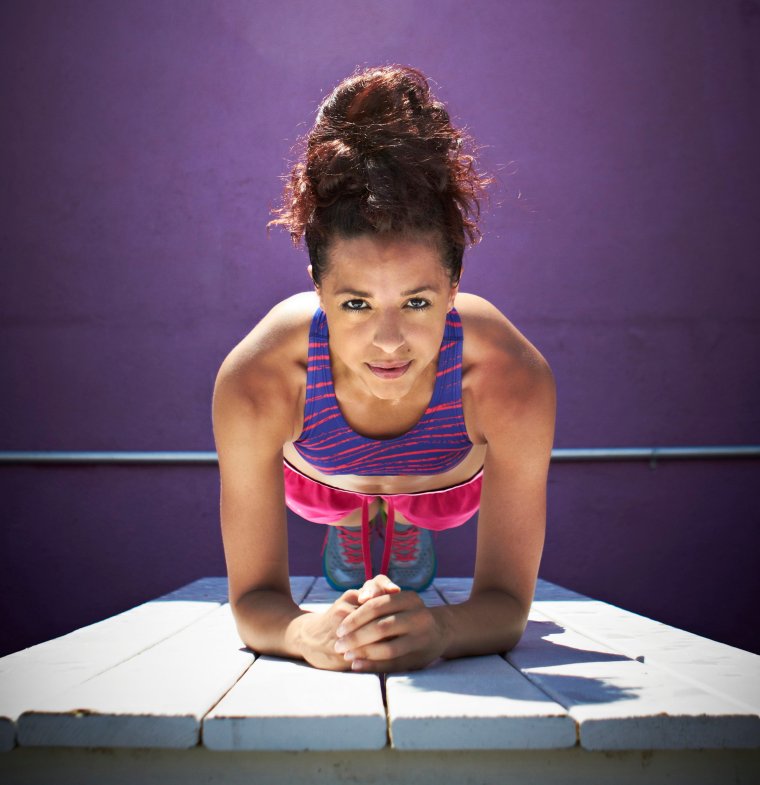
“I use this test with my personal clients as a measure of full-body endurance,” says Denoris. “It’s a time-based static test, so you’ll need a stopwatch handy.
How to do it
“Get down on the floor on your hands and knees, then lightly clench your fists and place your forearms under your shoulders on the ground,” says Denoris. “Now engage your abs and come up onto your leg so that only your feet and forearms are on the floor. Keep a straight line between your neck and ankles. Hold this position while breathing steadily and take how long you can stay there.
Criteria to aim for
“For men, those in their 20s and 30s should aim for 106-120 seconds; 40 and 50 year olds can aim for 40-100 seconds, and those 60 and older, around 25 seconds. For women, those in their 20s and 30s can aim for 90-100 seconds, it’s 30-90 seconds for those in their 40s and 50s, and 20 seconds for 60-plus.”
How to improve your score
“The principle of progressive overload applies, which means adding the plank exercise—and variations like the side plank—to your exercise routine,” says Denoris. “Start every other day and try to improve your score each time. As your body adapts, you’ll find that your time on the plank will improve, as will your muscular endurance and posture.”
The one leg balance test
“Testing balance is a good measure of lower body strength and coordination, and a useful way of assessing fall risk,” says Sam Bhide, an advanced physiotherapist at Kingston Hospital and spokesperson for the Chartered Society of Physiotherapy. It’s also linked to longevity: according to a study published in the British Journal of Sports Medicine, the longer you can balance on one leg, the more likely you are to live a longer life.
How to do it
“Stand with one foot off the floor,” says Bhide. “Put your hands on your hips and aim to stay there for 30 seconds. To add an extra challenge, you can close your eyes.”
Criteria to aim for
“Good results are as follows: 43 seconds with eyes open, nine with eyes closed for 18 to 39 years old; 40 seconds (open) and seven (closed) for 40- to 49-year-olds; 37 seconds (open) and 4.8 (closed) for 50 to 59 year olds; 26.9 seconds (open) and 2.8 (closed) for ages 60 to 69; 18.3 seconds (open) and two (closed) for ages 70 to 79; and for 80-plus, it is 5.6 (eyes open) and one second (closed).
How to improve your score
“You can improve your level by strengthening your calf muscles, which are very important when it comes to balance, coordination and overall stability,” says Bhide. “This is easy to do with calf raises when doing normal daily tasks, such as going up on your toes while brushing your hair, teeth or making a cup of tea.
#fit #age #tests #find