“It shows that our health system is unable to take care of Quebecers. It is dangerous when you consider that the population is getting older,” says the author of the study.
Article content
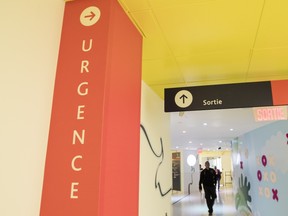
The number of patients who left emergency rooms in Quebec last year before being seen by health workers increased compared to five years earlier, according to the results of a study by the Montreal Economic Institute.
The study, made public Thursday, found that in the 11 months spanning 2023-2024, 3.2 million patients went to Quebec emergency rooms, and 11.5 percent of them – 376,460 people – left before being seen by a health professional.
Advertisement 2

Article content
By comparison, in 2018-2019, just over 10 percent of the 3.7 million patients who visited emergency rooms walked out before receiving treatment.
“One in two waits more than five hours to be seen at an emergency room in Quebec, so it’s not surprising to see many of them go,” said study author and economist Emmanuelle B. Faubert.
The study appears to confirm the findings of a regular report by McGill University’s department of emergency medicine, which painted a picture of the city’s emergency department in crisis, with several key indicators worsening at most hospitals over the past five years.
Patients who were referred by the emergency department to another health care provider who could attend to their needs were not included in the study as they were considered to have received medical care.
The report comes a day after Health Minister Christian Dubé said the coming summer will be “difficult” for patients as holidays cut into health care staff. About 1,500 hospital beds will be closed, about 115 fewer than in 2023. The healthcare network has a total of about 17,000 beds.
The Ministry of Health said in a statement that it had “again requested that each (health) institution quickly inform residents of the reorganization of services to ensure (their) predictability,” adding that decisions about services will be made locally to “respond to the specific needs of citizens” in every area.”

One reading of the day
Article content
Advertisement 3
Article content
Faubert said that even though Quebec’s health budget has increased annually over the past five years, the number of exits has remained essentially the same: “It’s a problem.
She was particularly concerned about the 103,715 patients who fell into the ‘urgent’ categories, P1, P2 and P3. According to Ministry of Health figures, 25.3 per cent of those who walked out before being seen were P3 (urgent) patients, 2.2 per cent were P2 (very urgent) patients and 0.03 per cent were P1 (resuscitation) patients.
Overall, the rate of P1-P3 patients leaving the emergency department was 21.9 percent in 2018-2019 and 27.5 percent in 2023-2024.
“It shows that our health care system can’t take care of Quebecers.” It is dangerous when you consider that the population is aging and its needs are increasing,” said Faubert.
For cases labeled P4 (semi-urgent) and P5 (not urgent), 70 percent decided to leave before being seen.
“People who are not urgent (cases) didn’t go (to the emergency room) because they wanted to go for a walk, they went because they needed help, urgent or not,” Faubert said.
Clinics run by specialized nurses are part of the solution, Faubert said, but Quebec needs to send more of them and do it much faster. She also described as “great news” the passage of Bill 67, which gives nurses and pharmacists more diagnostic latitude with patients.
Presse Canadienne’s health content is funded through a partnership with the Canadian Medical Association. Presse Canadienne is solely responsible for its editorial decisions.
Recommended by the editorial board
-

More and more Montrealers are leaving emergency rooms without seeing a doctor: report
-
Analysis: How ER waits in Quebec compare to those in England. Hint: terribly.
Advertisement 4
Article content
Article content
#People #walking #Quebec #treated #study